
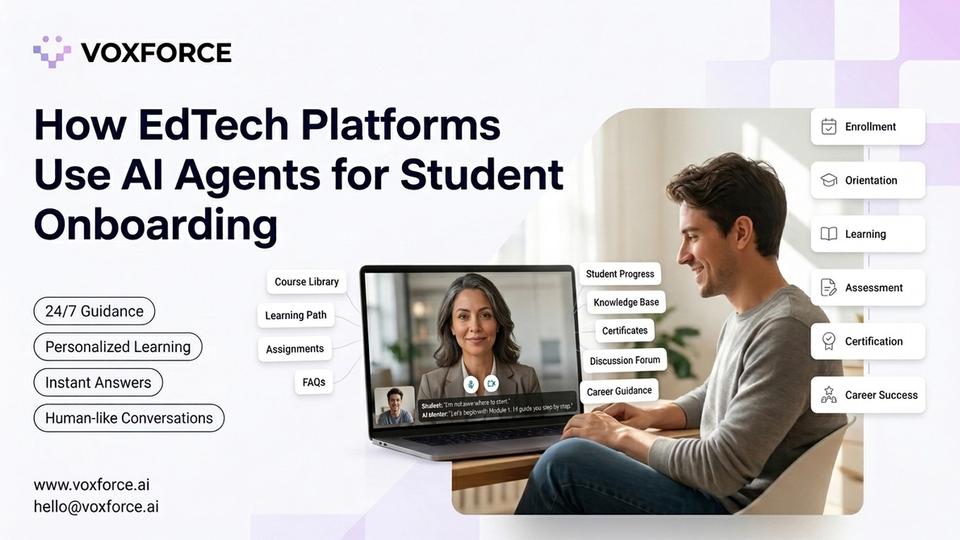
Student acquisition has become increasingly sophisticated across the education sector. Institutions and EdTech platforms invest heavily in marketing, outreach, and enrollment strategies to attract learners. Yet one of the most important stages in the student journey often receives far less attention than it deserves.
Onboarding.
For many learners, the period immediately after enrollment determines whether excitement translates into engagement. Students arrive with questions, expectations, uncertainties, and varying levels of familiarity with digital learning environments. Some are confident and self directed. Others may be entering online education for the first time. Regardless of background, the first few days often shape long term participation and success.
This is where many onboarding experiences begin to break down.
Students are typically presented with welcome emails, platform tutorials, instructional videos, FAQs, and support documentation. While these resources contain valuable information, they often place the burden of navigation entirely on the learner. Instead of feeling guided, students are expected to find answers independently and piece together their learning journey on their own.
As education increasingly shifts toward personalized digital experiences, a new approach is emerging. AI agents are helping EdTech platforms transform onboarding from a one time administrative process into an ongoing engagement experience that supports students from the moment they enroll.
At VoxForce.ai, we see this evolution as one of the most important opportunities in educational technology. The future of student onboarding will depend less on delivering information and more on helping students build confidence, familiarity, and momentum from day one.
The Biggest Onboarding Challenge Is Not Access to Information
Most EdTech platforms have already solved the problem of information access.
Students can typically find course materials, support resources, discussion forums, schedules, assessments, and learning guides within a few clicks. The challenge is not whether information exists. The challenge is whether students know how to use it effectively.
Consider a learner enrolling in a professional certification program. Within minutes of registration, they may receive login credentials, onboarding emails, course roadmaps, community links, assignment schedules, and platform tutorials. Every piece of information is useful. Yet the volume itself can become overwhelming.
This creates a paradox that many education providers face. The more information platforms provide, the harder it can become for students to identify what matters most at a given moment.
An AI onboarding agent addresses this challenge differently. Rather than presenting students with a collection of resources, it guides them through the learning environment step by step. A new learner can ask questions naturally, receive personalized responses, and move through onboarding at a pace that feels manageable.
The experience shifts from self navigation to guided exploration.
Student Expectations Have Changed
Today's learners bring expectations shaped by consumer technology.
They use platforms that recommend content instantly, personalize experiences dynamically, and respond in real time. Whether they are shopping online, consuming entertainment, or interacting on social media, they are accustomed to digital environments that adapt to their needs.
Education platforms increasingly operate within those same expectations.
Students no longer compare learning experiences only against other educational institutions. They compare them against every digital experience they encounter elsewhere.
A learner who receives personalized recommendations from a streaming platform or instant assistance from a digital service naturally expects a similar level of responsiveness when entering an online learning environment.
This is one reason traditional onboarding approaches often feel outdated. Static tutorials and lengthy documentation may contain the necessary information, but they rarely create the sense of engagement modern learners expect.
AI agents introduce a more interactive model. Instead of directing students toward resources, they create conversations that help students discover information naturally.
Why Early Engagement Matters More Than Ever
One of the most significant challenges facing EdTech providers is maintaining student momentum after enrollment.
Interest is typically highest at the beginning of the learning journey. Students are motivated, curious, and eager to get started. Yet this enthusiasm can fade quickly if learners encounter friction during the first few days.
A student who struggles to locate course materials, understand platform navigation, or clarify program requirements may begin disengaging before meaningful learning even begins.
This is particularly important for self paced courses, professional development programs, and online certifications where learners do not have the benefit of frequent instructor interaction.
Imagine a working professional enrolling in a six month data analytics course. Their schedule is already demanding, and their available study time may be limited. If onboarding feels complicated, every obstacle increases the likelihood of postponing participation.
An AI agent can proactively guide the learner through platform setup, explain course milestones, recommend starting points, and answer questions immediately. Instead of encountering barriers, the student experiences progress.
That early momentum often has a lasting impact on engagement throughout the learning journey.
From Administrative Onboarding to Learning Readiness
Historically, onboarding has been treated as an administrative exercise.
The objective was to ensure students completed registration requirements, accessed learning platforms, and reviewed essential documentation. Success was measured by whether students gained access to the system.
The future of onboarding requires a broader perspective.
The real goal is not platform access. It is learning readiness.
A student may successfully log into an online platform and still feel uncertain about where to begin. They may have access to every resource they need while lacking the confidence to navigate the experience effectively.
AI agents can help bridge this gap by focusing on preparation rather than simply access.
For example, a learner entering a coding bootcamp may benefit from guidance around prerequisite knowledge, recommended study habits, time management expectations, and project workflows. Rather than discovering these elements gradually through trial and error, students can receive contextual guidance tailored to their specific needs.
The result is an onboarding experience that prepares learners for success rather than simply introducing them to a platform.
How Conversational AI Creates More Personalized Student Journeys
Education has always been most effective when guidance feels personal.
Traditional classrooms naturally create opportunities for students to ask questions, seek clarification, and receive individual support. Digital learning environments often struggle to replicate that experience at scale.
Conversational AI helps close this gap.
A student beginning an online business program may have questions about course sequencing, certification pathways, assessment requirements, or career outcomes. Another learner in the same program may be focused on scheduling flexibility and workload expectations.
Both students require support, but their needs are different.
AI powered digital agents can adapt interactions based on context, goals, and behavior. Instead of delivering identical onboarding experiences to every learner, platforms can create journeys that feel more relevant and individualized.
This personalization becomes increasingly important as educational institutions serve larger and more diverse student populations.
Why Video AI Agents Can Transform Student Confidence
The next phase of onboarding may extend beyond text based interaction.
Many students learn more effectively through visual communication than written instructions. This is particularly true when navigating unfamiliar platforms, understanding workflows, or interpreting complex processes.
Imagine a student joining an online healthcare certification program. Rather than reading lengthy onboarding documents, they interact with an AI video agent that explains platform features, demonstrates learning pathways, and answers questions conversationally.
The experience feels less like reading documentation and more like receiving guidance from a knowledgeable mentor.
This distinction matters because confidence plays a critical role in student engagement. Learners who feel supported during onboarding are more likely to participate actively, complete coursework, and remain committed to long term goals.
Conversational video AI introduces a more human layer into digital education by combining explanation, interaction, and guidance within a single experience.
The Future of Student Onboarding Will Be Continuous
One of the biggest misconceptions about onboarding is that it ends after the first week.
In reality, students encounter new questions throughout their educational journey. Challenges emerge during coursework, assessments, projects, certification preparation, and career transitions.
The most effective onboarding experiences may therefore become continuous rather than event based.
AI agents enable this shift by remaining available throughout the student lifecycle. Support does not disappear once registration is complete. Instead, learners have access to guidance whenever new challenges arise.
This transforms onboarding from a short term process into an ongoing layer of student engagement.
The institutions that recognize this shift early will be better positioned to improve participation, satisfaction, and learner outcomes.
Why VoxForce.ai Is Building the Future of Student Engagement
At VoxForce.ai, we believe the future of education will be increasingly conversational, personalized, and learner centric.
Through conversational AI, AI video agents, and intelligent digital engagement experiences, educational organizations can create onboarding journeys that help students move from enrollment to participation with greater confidence and clarity.
The objective is not simply automation. It is helping learners feel supported from the moment they begin their educational journey.
As digital learning continues to expand, the institutions that stand out will not necessarily be those offering the most courses or the largest content libraries. They will be the ones that make learning easier to navigate, easier to engage with, and easier to succeed in.
A New Standard for Student Engagement
Education has always been about more than content delivery. The most effective learning experiences create direction, confidence, and momentum.
As EdTech platforms evolve, onboarding is emerging as one of the most important opportunities to shape those outcomes. Students increasingly expect guidance that is responsive, personalized, and available when they need it.
AI agents are helping make that possible.
By transforming onboarding from an administrative process into an interactive experience, they are redefining how educational institutions engage learners from the very beginning.
And in the years ahead, the most successful EdTech platforms may not be the ones that provide the most information. They may be the ones that make learning journeys the easiest to begin.