
There was a time when a product demonstration introduced buyers to software. Today, it serves a very different purpose. By the time a prospective customer requests a demo, they have often spent days or even weeks researching the market. They have explored vendor websites, compared competitors, watched product walkthroughs, read analyst reports, browsed review platforms, and discussed options internally. The demonstration is no longer the beginning of the buying journey. More often, it is the point where buyers seek validation for decisions they are already moving towards.
This shift has fundamentally changed what prospects expect from a demo. They are no longer looking for someone to read through a feature list or navigate every screen within the platform. They want answers that cannot be found on a website. They want to know how the product fits into their workflows, whether it integrates with existing systems, how quickly teams can adopt it, and what challenges they should expect during implementation. In other words, they are looking for context rather than information.
Many SaaS companies, however, continue to approach demonstrations as presentations instead of conversations. Every prospect sits through a similar walkthrough regardless of their industry, business model, operational priorities, or technical maturity. Valuable meeting time is often spent explaining capabilities that buyers already understand while the questions that actually influence purchasing decisions receive only limited attention.
At VoxForce.ai, we believe this is where the next evolution of enterprise software sales begins. Product knowledge should not remain confined to scheduled demonstrations or static documentation. It should be available as an intelligent conversation whenever a prospective customer wants to explore, evaluate, or understand a product.
Software Has Become Easier to Buy Than It Is to Understand
The SaaS industry has become exceptionally good at making information available. Product websites explain capabilities in detail, help centres contain thousands of support articles, comparison pages position products against competitors, and implementation guides answer technical questions. Buyers have access to more information than at any point in the history of enterprise software.
Yet the availability of information has not necessarily made purchasing decisions easier.
Every organisation operates differently. A customer relationship management platform that works perfectly for a technology startup may require an entirely different implementation approach within a multinational financial institution. An HR platform may solve completely different problems for a manufacturing company than it does for a professional services firm. Even organisations within the same industry often have unique workflows, approval structures, compliance requirements, and technology ecosystems.
The real question buyers are trying to answer is rarely, "What does this feature do?" Instead, they are asking, "Will this product work for my business?"
That question cannot be answered through documentation alone. It requires conversation.
The role of the product demonstration has therefore shifted from introducing software to helping customers understand how that software fits into their own environment. Organisations that recognise this change are beginning to rethink not only how demonstrations are delivered but also who delivers them.
The Best Product Specialists Cannot Be Everywhere
Every successful SaaS company has product specialists who consistently deliver exceptional demonstrations. They know which questions to ask, how to adapt explanations for different industries, when to simplify technical concepts, and how to connect individual features with measurable business outcomes.
Their expertise extends far beyond product knowledge. They understand customer psychology.
An experienced solutions consultant recognises when a prospect is worried about implementation complexity, uncertain about integrations, or concerned about user adoption. Rather than continuing with a predefined presentation, they adjust the conversation, address specific concerns, and build confidence gradually throughout the discussion.
The challenge is that this level of expertise is difficult to scale.
As organisations grow across regions, industries, and customer segments, every prospect cannot be matched with the company's most experienced product specialist. Sales teams become larger, demonstrations become more frequent, and maintaining consistency becomes increasingly difficult.
AI agents offer an opportunity to scale expertise rather than simply automate demonstrations.
Instead of replacing human specialists, they make their knowledge available much earlier in the buying journey, allowing every prospect to benefit from the same depth of product understanding before speaking with a sales representative.
Product Demonstrations Become More Valuable When They Adapt
The strongest demonstrations rarely follow a script because customer conversations rarely do.
Imagine two organisations evaluating the same customer engagement platform. The first is a growing startup looking for a solution that can be implemented quickly without adding operational complexity. The second is a global enterprise managing millions of customer interactions every month across multiple business units and countries.
Although both organisations are evaluating the same product, the factors influencing their purchasing decisions are entirely different.
The startup wants speed, simplicity, and affordability.
The enterprise is focused on governance, scalability, security, integrations, and long-term operational resilience.
A traditional demonstration often presents the same sequence of features to both audiences because it follows a standard presentation.
A conversational AI agent approaches the discussion differently.
Instead of beginning with a predetermined product tour, it begins by understanding customer objectives, existing workflows, operational priorities, and expected outcomes. The demonstration evolves naturally as the customer asks questions, explores scenarios, and requests additional clarification.
The conversation feels less like watching a presentation and more like collaborating with someone who understands the business problem being solved.
That difference has a significant impact on buyer confidence.
Why Video Changes the Product Demo Experience
Enterprise software has always been visual. Buyers want to see dashboards, workflows, reporting interfaces, automation capabilities, and administrative controls before making purchasing decisions. Video has therefore become one of the most effective ways to explain software because it combines demonstration with explanation.
Conversational video AI builds on this strength by making demonstrations interactive rather than linear.
Instead of watching a predetermined recording, prospects engage with AI video agents that explain capabilities, answer follow up questions, explore alternative use cases, and adapt demonstrations in real-time. Customers are no longer limited to the sequence defined by the presenter. They control the direction of the conversation.
Consider someone evaluating a customer support platform. One prospect may want to explore AI-assisted ticket routing, while another is interested in multilingual support, reporting capabilities, or CRM integrations. Rather than scheduling separate demonstrations or waiting for additional follow up meetings, both customers can immediately explore the topics that matter most to their organisations.
The result is not simply a better demonstration. It is a better buying experience because customers receive guidance that reflects their priorities rather than a generic presentation designed for everyone.
Every Product Conversation Is Also a Sales Conversation
One of the biggest misconceptions about software demonstrations is that their purpose is to explain products.
In reality, their purpose is to reduce uncertainty.
Every question a prospect asks reveals something about their buying journey. Questions about integrations often indicate technical evaluation. Questions about onboarding suggest implementation planning. Discussions around reporting may reflect executive requirements, while conversations about security typically signal procurement involvement.
These signals help sales teams understand not only what customers are evaluating but also where they are within the purchasing process.
AI agents capture these insights naturally through conversation. Instead of relying solely on lead forms or discovery calls, organisations develop a richer understanding of customer intent based on the discussion’s prospects choose to have.
By the time a human sales representative joins the process, they already understand the customer's priorities, likely objections, technical requirements, and business objectives. Meetings become more consultative because less time is spent gathering information and more time is devoted to solving problems.
This transforms demonstrations from isolated events into continuous conversations that move prospects steadily towards confident purchasing decisions.
From Product Knowledge to Organisational Knowledge
Customers evaluating enterprise software rarely limit their questions to features.
They want to understand implementation timelines, onboarding processes, pricing models, security frameworks, API capabilities, migration strategies, training programmes, customer support structures, and long-term product roadmaps.
The expertise required to answer these questions rarely exists within one department.
Product managers understand why features were built. Sales engineers explain integrations. Customer success teams know which onboarding practices deliver the fastest adoption. Support teams resolve thousands of practical issues every month, while implementation consultants understand the challenges customers experience during deployment.
Collectively, this knowledge represents one of a SaaS company's greatest competitive advantages.
Yet much of it remains distributed across documents, internal systems, teams, and individual experience.
The opportunity is not simply to automate demonstrations. It is to make organisational expertise conversational.
How VoxForce.ai Is Redefining Product Demonstrations
Every SaaS company already possesses extraordinary knowledge about its products. The challenge is not creating more content or publishing more documentation. The challenge is making that expertise available whenever prospective customers need guidance.
At VoxForce.ai, we believe information alone does not create clarity. Conversations do.
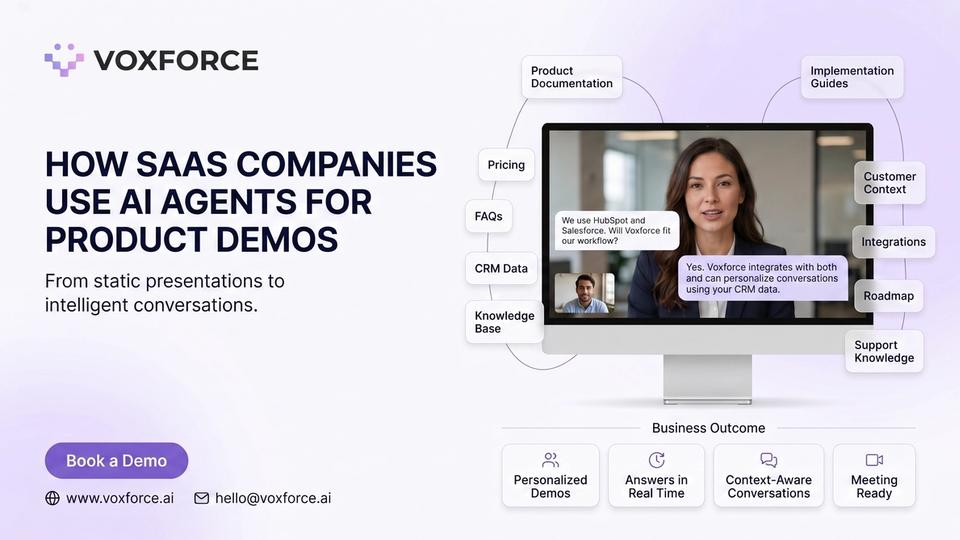
VoxForce acts as the intelligence layer that transforms enterprise knowledge into real-time human conversations. Businesses can create AI-powered humans trained on product documentation, implementation guides, CRM data, support knowledge, and organisational expertise, allowing prospects to engage naturally through conversational video AI rather than navigating disconnected information sources.
These AI agents do more than answer questions. They explain products in context, recommend relevant capabilities, guide demonstrations according to customer objectives, support onboarding journeys, and maintain a consistent brand experience across every customer touchpoint.
This is not simply a new approach to product demonstrations.
It represents a new way for enterprise software companies to communicate with their customers.
The Future of Product Demos Is Continuous Conversation
The next generation of SaaS companies will not compete solely through product innovation or feature velocity. Those factors will always remain important, but customer experience during the buying journey is becoming an equally powerful differentiator.
Product demonstrations will increasingly evolve from scheduled presentations into continuous conversations that begin the moment a prospect expresses interest and continue throughout evaluation, onboarding, adoption, and expansion. Customers will no longer wait for product expertise to become available because it will already be embedded within every digital interaction.
For SaaS companies, this shift represents more than another application of artificial intelligence. It represents a fundamental change in how software is introduced, understood, and ultimately purchased. The organisations that embrace conversational product experiences today will be the ones that define how enterprise software is bought tomorrow.